
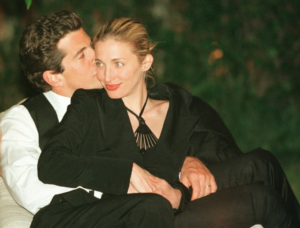
Hulu’s Love Story has introduced an entirely new generation to the glamour of the Kennedy family, this time with a particular focus on Carolyn Bessette Kennedy and her relationship with JFK Jr. Since the release of the show, social media has been inundated with images of the couple: grainy paparazzi shots, glossy editorials, scenes of them arguing in a park, impeccably dressed. Influencers peddle product, promising that with the right headband or Calvin Klein skirt, you too can “bag a Kennedy.” The implication is clear: Bessette’s allure can be reverse-engineered through consumption. But what made Carolyn Bessette Kennedy compelling wasn’t reducible to objects. It was a form of embodied cultural capital, a socially cultivated ease that cannot be purchased, only internalized over time.
Carolyn Bessette didn’t rise to cultural prominence due to tailoring alone, nor was her appeal reducible to appearance. What she projected was not relatability or curated vulnerability, but habitus–embodied dispositions that appeared effortless because they were so deeply ingrained. She moved through the world with a marked lack of performance: minimal gestures, restrained expressions, a refusal to smile on command. Her appeal stemmed from the impression that she wasn’t trying.
Pierre Bourdieu’s concept of embodied cultural capital clarifies this distinction. For Bourdieu, taste is not a matter of preference, but of training. The elite do not simply possess desirable objects; they internalize durable ways of speaking, standing, reacting, and judging that come to feel natural. This embodied capital “classifies the classifier”–it signals belonging without proclaiming it. Crucially, embodied capital is slow to acquire. It cannot be downloaded through aesthetic choices because it’s inscribed in posture, speech rhythms, reactions to scrutiny–in the body itself. Bessette’s appeal was not just that she wore minimalism, but that she inhabited it without visible strain. A cool somatic response to intrusion–paparazzi shouting, cameras flashing–cannot be purchased alongside a silk skirt.
After her parents’ divorce, Bessette was raised in suburban Connecticut in environments where social positioning mattered–first in Catholic school, later at Boston University, and eventually within the rarefied corporate culture of Calvin Klein. There she rose from sales associate to director of publicity, handling high-profile clientele and learning discretion, aesthetic restraint, and institutional fluency. Long before she became a tabloid fixation, she had been trained in how to move through rooms where status was assumed rather than declared. What appeared as effortless cool was, in Bourdieu’s terms, sedimented habitus.
This pattern reflects what Annette Lareau describes as “concerted cultivation.” In Unequal Childhoods, Lareau observes that affluent families raise children to feel comfortable within institutions. They learn to question authority, negotiate rules, and assume their presence is legitimate. That training produces adults who navigate elite spaces without visible anxiety. Bessette’s composure was not accidental–it was rehearsed long before the paparazzi arrived.
The issue with TikTok recreations of Bessette isn’t that they get the headband wrong. It’s that they mistake objectified capital for embodied capital. The recreation centers the outfit, explains the reference, and tags the brands. But embodied cultural capital derives its power from misrecognition: it works because it appears natural rather than strategic. Social media renders misrecognition difficult, if not impossible. Effort is visible; strategy is explicit.
Bessette’s public life unfolded within a media environment defined by scarcity. Images were limited, interviews rare, access restricted. Scarcity amplified allure and allowed habitus to remain opaque. Influencer culture, by contrast, operates within an economy of constant disclosure. Visibility is monetized. The self must be continuously narrated. Under these conditions, embodied capital cannot remain unspoken; it must be performed. And once performed, it loses the quality that made it powerful.
There is a difference between wearing minimalist clothing and being minimal–between styling aloofness and inhabiting it. Besette’s appeal lay in the latter. Our obsession with recreating her image reveals not just nostalgia for the 1990s, but a longing for the symbolic order that her image represented: elite stability, institutional continuity, social coherence. But embodied cultural capital is cumulative and relational. It is produced through family, schooling, and institutional familiarity. It cannot be reverse-engineered through consumption because it was never merely aesthetic. Attempts to imitate Bessette expose a broader fantasy of mobility: that elite ease, and perhaps even national steadiness, can be accessed through taste rather than through the slow, unequal accumulation of power.
The resurgence of the Kennedy mythos coincides with a prolonged period of political instability in the United States. In an era marked by polarization, institutional distrust, and the spectacle of populist politics, the Kennedy era is often selectively remembered as a time of coherence and dynastic continuity. Bessette becomes a vessel for that longing. Her restraint stands in stark contrast to the performative excess that now characterizes both political and digital life. The appeal isn’t merely sartorial; it’s symbolic. To resurrect Bessette is to gesture toward a fantasy of American elite stability, a world where power appeared composed and self-assured.
Yet this nostalgia obscures what Bourdieu makes clear: elite composure is not moral superiority, but the effect of accumulated capital. The Kennedy mythos, like Bessette’s coolness, was sustained by inherited networks, institutional power, and symbolic authority. What appears as grace is often the embodied expression of accumulated and inherited advantage.
Related posts:
 January 6th: The Art of Conspiracy
 The Problem with Social Media
 Destroying Art in Protest: Is it Worth it?
 Is Election Season Brat?
 The Need for Autonomy in Indigenous Media Representation
 The Dark Side of Artistic Freedom
 Zach Bryan and Brianna Chickenfry: Their Love ‘Fried’ Out
Powered by YARPP.
This article was very interesting to read after recently watching the Hulu hit “Love Story” and seeing Carolyn Bessette gain her influence again in 2026. Additionally, the phenomenon of Carolyn Bessette and Bourdieu’s concept of embodied cultural capital relates to Goffman’s concept of presentation of self in everyday life, especially his idea of manner expressed through posture, speech, and reactions. Bessette’s minimalist clothing reflects her appearance, while the effortless way she wore her outfits communicated elegance. Her basic white tee, blue jeans, and headbands became representative symbols of her as an individual and extended beyond the pieces of clothing.
This article made me consider the allure of Carrolyn Bessette Kennedy, and why pop culture decided that she was a fashion icon since the 2026 show, the Love Story was released. When you consider her style it’s generally minimalistic: blue jeans, white t-shirts, headbands, but the internet reacted like it was revolutionary. It was interesting how this article broke down that the style was not what people were having a reaction to, instead it was the lifestyle that she represented. An everyday girl who came from a “good” background turned into American royalty while staying elusive to the public eye. She also represents a time of the Kennedy era political stability during a time when America’s views feel so divided. The context behind the CBK era is what sparks such interest, in a non pronounced way.
Wow what a compelling point. In the modern era, it seems that certain nostalgic figures of status and power are contineously idealized through social media. Like the Carolyn Bessette “trend,” people have also attempted to clone iconic individuals such as Princess Diana and Paris Hilton when in reality these individuals cannot be recreated through fashion and imagery. They posses embodied capital which has been long instituionalized into their habits and mannerisms. Therefore, to become these individuals is impossible as the overall mannerisms which led to their “icon status” are those which were conditioned rather than purchased or practiced.
I thought this analysis was reflective and dissective. The analysis of the public’s increased infatuation with Carolyn Bessette is strongly correlated to the lack of interactions Bessette had with society and media compared to present day, where more media and more “airtime” equals more money. I like how you stated that it was “internalized over time” because often the infatuation we have with celebrities from past eras is not how we saw them then, much like the posthumous paradox. Only when we are surrounded by the opposite do we miss the “simplicity” of a time or a person society intensifies it. I also enjoyed how you added the effect of JFK Jr. and the relationship into Bessette’s dramatization, however you did not make it the main driver for the public’s infatuation with her which I appreciate because you dove deeper.
honestly this hits different knowing how much of the “kennedy aesthetic” people are trying to buy now when the whole point was that it couldn’t be bought—like all those influencers selling headbands completely missed that she just… wasn’t performing
An excellent analysis. Greta Liu hits the nail on the head regarding the difference between objectified capital (clothes) and embodied capital (gestures). In the TikTok era, where everything must be marketed, Bessette’s ‘coolness,’ which rejects performance, becomes impossible to replicate. We try to consume an identity whose power lies in its refusal to be consumed.