
Through various films and television productions, we witness countless scenes that are unseen or unusual in everyday life, from thrilling police-robber shootouts to gruesome, bloody crime scenes. These are themes that most people would undoubtedly classify as crime, and among these themes is the not-so-small category of “cannibalism.”
Both in terms of camera language and scriptwriting, films and television often romanticize their themes to make them more accessible to a wide audience. The most common examples are glamorized romantic themes or heroic films starring perfect protagonists. These aren’t inherently problematic; after all, most people watch films and television for that unrealistic romance and perfection that satisfies the realities of life.
Similarly, in violent crime or thriller-style gore, if a director’s portrayal is too realistic, they risk losing certain audiences. Consequently, an artistic style that romanticizes crime has emerged. This can involve a handsome, intelligent protagonist robbing banks and giving to the poor, or a traumatized, sympathetic killer.
Today, let’s focus on the narrow topic of cannibalism. When cannibalism is aestheticized, is it possible for audiences to no longer be shocked by the gore and cruelty, but instead appreciate it with an aesthetic distance, or even develop a reverent attitude, blurring the lines between morality and justice?
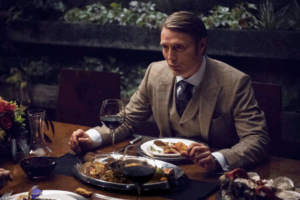
Take Hannibal and Bones and All as examples. Although their styles and storylines differ, they both represent the “aestheticization of cannibalism.” In Hannibal, Hannibal Lecter is a psychiatrist and a cannibalistic serial killer. He counsels his patients, yet subconsciously manipulates and suggests their behavior and thoughts. While this may be somewhat exaggerated, it’s unethical for a doctor to manipulate others’ minds. Furthermore, his killing of multiple people and consuming them himself or feeding them to others is a crime that should be horrifying. Yet, this character remains incredibly popular, with viewers praising his refined taste, exquisite cooking techniques, clean and efficient killings, and masterful mental manipulation. In Hannibal, the ornate plating, classical music, and artistic composition all serve to transform cannibalism into a “culinary art” and a “personal ornament.” It also becomes a symbol of power and manipulation, deviating from the fact that it is a serious criminal act.

In Bones and All, Maren Yearly, born with an urge to engage in cannibalism, embarks on a journey to discover her roots after being abandoned by her father. This journey symbolizes a search for identity and a realization of desire. This is exacerbated by her encounter with Lee, a fellow cannibal. Their journey together is a tangled tapestry of lust and desire. Unlike Hannibal, cannibalism is not glorified as art, but rather entangled with adolescence, loneliness, and lust; bloodshed and tenderness coexist. If Hannibal embraces the most extreme taboos, then Bones and All explores them.
The above examples demonstrate that current film and television themes are more flexible and bold, and even sensitive themes are deliberately packaged, concealing the crime itself behind glamorized plots, actors, and camera angles. In Hannibal, the overly aestheticized cannibalism renders violence “commoditized” and “normalized,” potentially leading viewers to unknowingly step into a gray moral terrain. In Bones and All, cannibalism serves as a metaphor for adolescent desire and self-identity, and young viewers may be drawn in by the plot’s portrayal of “love and belonging,” developing a yearning for and admiration of these supposedly suppressed desires.
In summary, in both Hannibal and Bones and All, the concept of cannibalism ceases to be merely a “horror film gimmick” or an “extreme example of crime” and is instead situated within a cultural and aesthetic context, inviting new interpretations. The differences between the two works demonstrate how, in modern media, cannibalism can both reflect desensitization to violence and challenge ethical norms. More importantly, it highlights how cannibalism, as the “ultimate taboo,” continues to derive new meanings within diverse cultural frameworks. Will this sow the seeds of a social and moral hidden danger?
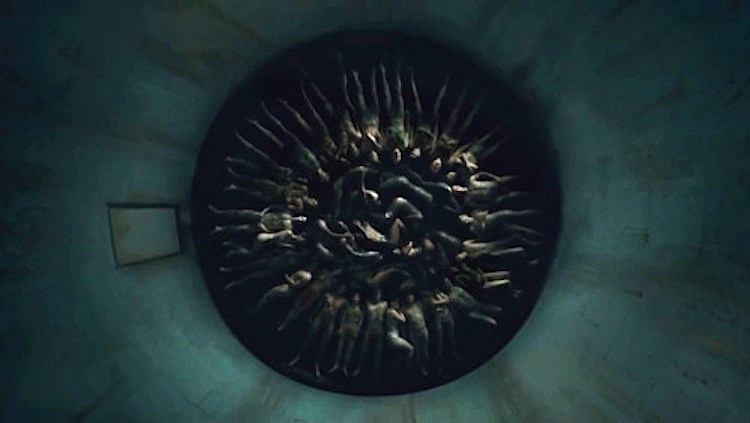





Hollywood frequently portrays murderers in a romanticized light, which has led certain netizens to respond in ways that I do not believe they would in the real world. I believe that audiences can interpret cannibalism in different ways, just as many types of crimes in works of media can be interpreted. It is interesting how we have become desensitized to these horrific crimes as a way to express another idea.