
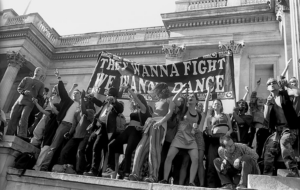
“Rave has become the embedded soundtrack to effective public opposition to government, and people have learned a more sophisticated approach to non-violent direct action.” This music, with its ability to bring people of all classes, races, origins, etc. together, has transformed and been used as a tool for social growth throughout the past 50-odd years. Simultaneously, it has been opposed by authorities due to its freeing, “uncontrollable” nature.
In the 1970s, pioneering disco began paving the way, long songs featuring a repetitive bass drum beat, instrumental sounds from electric guitars and pianos or synthesizers creating horn sounds. Women with big voluminous hairstyles, outfits featuring bright colors, sparkles, short shorts, halter tops, and big boots. This was the “uniform” of this type of musical experience. A free, fun, funky outfit paired with the bright, swirling light, heavy bass, and friendly community. Disco flourished in places with a club culture and in LGBTQ+ and minority communities. Disco offered these communities and everyone a place to freely express themselves without fear of opposition or disapproval. Places such as these were extremely difficult to come by at this time. However, outside the club, parking lot, or venue where this music was being played, there was opposition. The uproar of disco posed as a threat to the then-reigning “dad rock” culture of straight white males at the time. It is also undeniable to mention the introduction of party drugs such as “disco biscuits” (quaaludes) and cocaine, which were used by some to accentuate their atmosphere and experience. This was also another point of opposition for people against disco: the illegal usage of drugs at events and playing the music.
When the 1980s arrived, shifts towards raving today were made. I think it is important to note the new styles of music introduced after the disco genre; the opposition of the community and the people in it increased, and the intensity, beat, and strength of the music also intensified. In the 80s, house and techno music emerged, both in the United States and other European countries, and the movement had become worldwide. Though it spread in reach, parties and venues playing this music were forced to become more “underground”. Underground raves and parties like these are on a need-to-know basis; the venue location is not announced till a couple of hours before, it’s invite or seek out only, it is not an advertised highly, organized event. These parties are illegal, unregulated, and a place to truly be free, also a place to avoid the authorities and risk of commercialization. As this music became popular commercialization was a fear of many pioneer minority DJs. In the 1980s, the popularity of the music caused credit, profits, and the culture to be sloppily adopted and replicated by promoters, other DJs, and companies. Stealing ideas from small DJs to gain a profit and popularity, not contributing to the community of music or the real purpose in any way.
By the 1990s, government and corporations attempted to regulate it, but the community persisted. The corporations present in raving have been forced by the community to abstain the standards and culture that have been found to be upheld for years. When there is an event or an individual who doesn’t support and uplift the community, they are simply not supported. The culture of present-day raving is defined by PLUR: peace, love, unity, and respect. Previously underground raves such as EDC (Electric Daisy Carnival) that began as an underground rave in the 1990s in Los Angeles have flourished into one of the most well-organized, attended, and loved festivals in the world. This is an example of a loved festival that is put on by a larger rave company. Though there are artist organized festivals such as Lost Lands that are just as, if not more, of a thought-through experience that integrate small upcoming artists alongside the ones who are the foundation of current day raving.
Today, however, raving faces the effects of mass media fascination. This fascination has created a noticeable increase of people going to raves and listening to the genres of music that are a part of the greater community. This has exhibited some possible threats to the philosophy, PLUR, which is the whole point of raving. Mainstream raves have brought crowds who don’t honor and respect PLUR encouraging fights, disagreements, and an overall unpleasant experience. This causes lost lasting members of the community to move back to underground raves, lightly advertised, secret/unsanctioned locations, and mostly illegal. PLUR is alive at these underground raves; however, drug testing stations are not available, naloxone in case of an unexpected overdose, or just something as simple as safe parking. This forced retreat of the community by mass media has brought raving back to the times where hiding and secrecy was necessary to find an accepting, uplifting, fun place to let go of problems and be free.
An unfortunate pattern is made clear: finding community, it becomes commercialized, forced retreat by traditional community members, and then a powerful overcoming of the commercialization. The fight is never over for the marginalized individuals who have fought for raving, PLUR, and a place to be unapologetically themselves.