
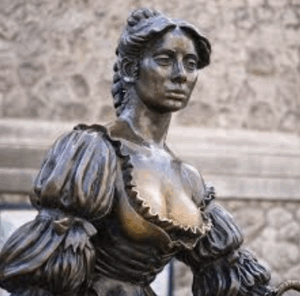
Molly Malone is a woman featured in an Irish folk song. Legend has it that Molly sold mussels and clams until she died of a fever in the 17th century. While it is unknown whether Molly was real, or purely fictional, her story is known across Ireland. Due to her popularity, a statue of Molly was erected on Suffolk Street, in Dublin Ireland, in December of 1988. The statue of Molly quickly became a popular tourist attraction. However, over the years the statue has come under controversy. This is not due to the statue of
Molly itself, but how people interact with her.
It started as a superstition. People began rubbing Molly as a way of ensuring that they would have good luck. Others rubbed her as a way of ensuring that they would return to Ireland someday. Tour guides spoke of these superstitions, and it quickly became common practice to rub Molly. Unfortunately, what began as an innocent form of goodluck became an act of disrespect.
Disrespectful tourists began to rub Molly’s breasts, leaving this specific part of the statue with extreme discoloration. Tourists are often photographed groping Molly. Not only has the practice been harmful to the statue, but it is also representative of the objectification that women all around the world endure on a daily basis. The discoloration of the statue is indicative of a larger problem, violence against women. The state of the statue has led to much criticism and backlash. In response, The Dublin City Council put into place a campaign called “Leave Molly mAlone”. Others took it upon themselves to plant flower beds around the statue, in order to take focus away from Molly. Nevertheless, the objectification of the statue has not diminished. The city of Dublin recently went as far as taking them away to repaint the parts that had been discolored, only for the discoloration to quickly return once Molly had been put back. Not only is this disrespectful to the artist, and the statue itself, but to Molly and the rest of the women around the world. Just because a statue of a woman is somewhat immodest does not mean that people have the right to objectify and grope it. This issue is deeply layered, and not just a funny gag for a picture. The objectification portrays a lack of respect for women and their bodies, and the disrespect of a wonderful piece of art.
Related posts:
 Gold, the Symbol of Misogyny
 Feminist Pints, The Artistic Crime
 Guerrilla Girls See Blurred Lines very clearly
 George Floyd vs. Racist Figures
 Bad Bunny embodying & bringing awareness to feminist views
 Feminism, The Cause of Andy Warhol’s Death?
 The Women, Artists, and Cultures Behind Picasso
Powered by YARPP.
I think that this statue is a great example of how women are being literally objectified. When presented with an inanimate figure of a women the first instinct of men (and also some women don’t come for me) is to objectify and violate her. I think this shows more than one may think about the status and position of women in our society. People are so quick to reduce a women’s contribution and efforts to her physical appearance so much so that they will create new stories about it being “good luck” or “superstitious” as an excuse for bad behavior. Women are constantly targeted because of their bodies and appearance and by allowing excuses to be made for this behavior we are all complicit in the objectification and sexualization of women real or inanimate.
I have seen the Molly Malone statue in person, and my first reaction was to ask my mom why her chest was discolored. I didn’t think to ask who she was, what she did, or anything about why there would be a statue of a woman holding a cart. And that is the problem. The tourist tradition takes away the true representation of the artwork. I could not ever imagine disrespecting a piece of art that holds cultural significance to the locals, even if it will “grant one good luck”. Tourists are entitled to treat historical landmarks differently than they would in their own country.
I have been fascinated by this statue for a while, but never knew its origins so that was so interesting to learn about! I think Molly is unfortunately such a good metaphor for how women are constantly disrespected, and even when you try to fix it, the stains of the past are still there. It is crazy that people see the discoloration of the statue and continue to make it worse, not seeing the hurt that it’s already caused. Also, weird that people use a literal inanimate object to abuse just because it can’t fight back – it’s indicative of how women were treated before they spoke up.
This statue proves to be an example of the constant objectification women experience in their lives daily. Whether it is catcalling, sexist comments, or even microaggressions, it puts women in uncomfortable situations. Even though the Molly Malone statue is “just a statue,” it doesn’t give men or anyone the right to be inappropriate with it, as it just proves the constant disrespect that women face. I have experienced uncomfortable situations such as these more times than I can count. For example, when I am going out at night or walking along the street during the day, men will whistle and make comments out of the window as a “joke”. To me, it isn’t a joke; it is just sexist, and it represents what is happening with the statue as well. To some, it is a joke, but to many it’s pure disrespect and contributes to the violence and sexualization that women experience.
This statue is a great example of how people’s disrespect towards women is diminished due to the insignificance of the situation. Although it doesn’t seem to be a big deal that people are disrespectfully touching this statue, efforts to prevent this haven’t worked because men think it’s “just a joke” or “not a big deal”. This has happened in my life more times than I can count, and this frustration is shared amongst other women in my life. For example, when I try to call a man out for a sexist comment, they always say that it’s a joke or that it’s just one comment that doesn’t matter, when in reality it does matter because it contributes to the overall issue of injustice and disrespect towards women.