
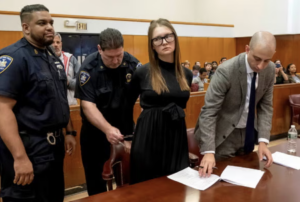
Anna Delvey did not take a painting from the museum. She has never broken a window or busted a safe. She just convinced a large number of people that she was wealthy, which was just enough too scam her way through New York City.
Delvey’s actual name is Anna Sorokin. She grew up in Germany and relocated to New York in the 2010s, when she began to tell people she was a German heiress with a large trust fund. She wore the part, advertized the part, and performed the part. Instagram had a major role. Her feed made her appear like she belonged in the room, and people believed it because it was so polished. Social media made it simple to spoof a whole identity.
Her main desire was the Anna Delvey Foundation, a private arts club set to take over a massive historic building in Manhattan. It would have included exhibitions, events, and famous artists. To make it happen, she attempted to actually get a $22 million loan with fake financial documents. The money never came through, and the entire scheme was based on lies. However, the idea demonstrates how art can be exploited as a status symbol. People avoid asking questions about an arts foundation because it seems nice and trustworthy.
While she waited for the loans, she lived on other people’s money. Prosecutors said she stole over $275,000 from banks, hotels, and acquaintances. One friend was stuck with a large cost for a luxury trip to Morocco that Delvey promised to cover. Surprisingly, the jury found her not guilty of the charges related to that trip. However, in 2019, she was found guilty of grand larceny and theft of services, among other charges. She was sentenced to four to twelve years in prison and ordered to repay around $198,000, plus a $24,000 fine.
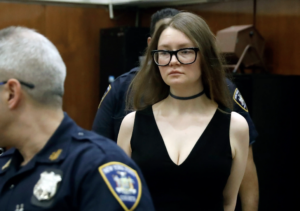
This is where the narrative turns odd. She didn’t completely disappear after that. Her narrative was created by the Netflix series Inventing Anna. Delvey reportedly received $320,000 for her story. While in ICE jail awaiting deportation, she began selling her own work, including drawings she created in custody. She also amassed a sizable internet following and established an NFT initiative. So the same woman who duped people with a phony image now profits from her genuine one.
That is what distinguishes her case as an art crime rather than a typical fraud case. Many people online consider her as a girlboss antihero rather than a criminal. She’s got fans, merchandise, and a brand. However, there were genuine victims, and some of them were ordinary citizens who had to pay actual money. It’s easy to forget when the story is wrapped in fancy attire and excellent editing. Even her art displays have been dramatic. A curator who assisted with one of her pop-up exhibitions said Delvey owed her thousands of dollars.
There is also a gender aspect. Female fraudsters, like as Delvey, are often made into style icons and Halloween costumes. Would a male who did the same thing receive the same treatment? Some claim that the public admires her because she took advantage of wealthy institutions and circles. However, not all of those who were injured were billionaires.
Her artwork complicates matters even more. When an artist is well-known for defrauding others, is the artwork valuable for its artistic merit or for the scandal? Her dealer valued one collection of her sketches at $500,000, and customers are not simply purchasing a drawing. They’re purchasing a portion of the Anna Delvey narrative. That raises larger problems in the art industry, such as whether notoriety increases the value of art and if criminals should profit from their crimes.
Delvey’s story demonstrates how simple it is to fabricate credibility, especially with social media and art on your side. It also demonstrates how rapidly the internet can convert a fraud into fun. Perhaps the biggest mystery isn’t how she accomplished it. This is why we continue to reward her for it.
Related posts:
 Frank Abagnale: Con Man
 The Con-Artist: Frank Abagnale Jr.
 Dancing with a Con Artist
 Ed and Lorraine Warren: The Frauds and Grifters of Ghost Hunting
 When True Crime Stops Being True: Netflix’s Commercialization of the Lizzie Borden Case
 From MK-Ultra to Hawkins Lab: Representing Government Abuse in Stranger Things
 When Murder Becomes Content: The Art and Exploitation of True Crime
Powered by YARPP.
Now I want to see her drawings along with a critical explanation of how Chris Martine, a representative of Founders Art Club, substantiated its value at half a million dollars.