
|
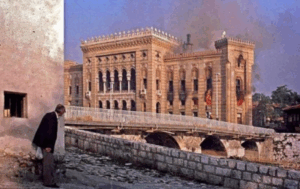
When Yugoslavia dissolved in the early 1990s, the resulting violence didn’t just claim human lives. It claimed memory itself. Across Bosnia, Croatia, and Kosovo, libraries, museums, archives, bridges, mosques, and churches were intentionally burned, shelled, or erased. In these conflicts, cultural heritage becomes a front line, not collateral damage. The Yugoslav Wars weren’t only military conflicts; they were wars against memory. This wasn’t random destruction. It was a strategy. And it complicates how we understand “art crime.” In the Balkans, the destruction of cultural property functioned as a form of political violence, aimed at severing communities from their histories and legitimizing ethnic cleansing under the guise of war. Killing Knowledge: The Burning of Vijećnica – Sarajevo, 1992On August 25, 1992, the National and University Library of Bosnia and Herzegovina– Vijećnica– was shelled from the hills above Sarajevo. The building burned for days. Firefighters were shot as they tried to extinguish the flames. Inside, more than two million books, manuscripts, and archival items were reduced to ash. Libraries aren’t militarily strategic. They don’t house weapons. This was symbolic violence: an attempt to erase Bosnian Muslim intellectual, historical, and cultural presence. As photographs show pages floating through the city like burning snow, the intention becomes unmistakable– to destroy a people’s memory.If art crime can be described as the wrongful loss of cultural property, then this was one of the largest single acts of art crime in Modern European history.
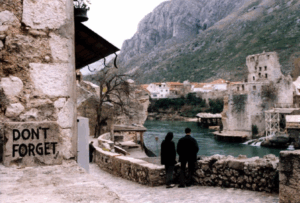
Erasing a Bridge Between Worlds: Stari Most – Mostar, 1993Few objects symbolize the multicultural Balkans more than the 16th-century Stari Most, an Ottoman bridge arching over the Neretva River. For centuries, it linked not only two banks of a river, but two worlds: East and West, Muslim and Christian, tradition and modernity. In November 1993, Croatian forces destroyed it with deliberate shelling. The act did not simply eliminate a piece of architecture; it ruptured a symbolic connection between communities. Destroying the Stari Most announced the death of the diverse Mostar that once existed. UNESCO later rebuilt the bridge in 2004, but the reconstruction raises a deeper question: can memory be rebuilt, or can it only be mourned? A new bridge may restore the skyline, but it cannot restore the trauma or loss of meaning attached to the original.
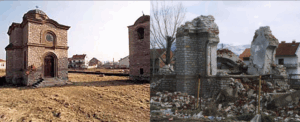
Kosovo: Heritage Taken HostageIn Kosovo, cultural destruction was cyclical and retaliatory. In the late 1990s, Serbian forces burned Albanian cultural centers, mosques, and state archives. After the war and during the 2004 unrest, Albanian mobs targeted Serbian Orthodox monasteries, churches, and graveyards. Heritage became a proxy for political claims. Destroying a site was a way of asserting the idea of “you were never here.” The logic is chillingly simple: erase the past, and you weaken people’s claim to the present.When every side attacks the symbolic markers of the other, cultural crime becomes self-perpetuating, a loop of erasure responding to erasure. Post-conflict reconstruction efforts were massive, but rebuilding is not the inverse of destruction. Restoration can help stabilize memory, but it cannot resurrect what was lost. A reconstructed building is an act of hope, but also an admission: the original is gone forever. The repaired heritage carries the scar of the violence, becoming a part of its meaning. The Yugoslav case reminds us that cultural destruction is not peripheral to war; it is central to it. When we lose art, archives, and monuments, we can lose the evidence of identity. We lose stories. We lose the ability to understand who we were, and who we might have been. Art crime in wartime is not just a legal category. It is a form of violence against memory, where the crime’s consequences outlast the lives of the perpetrators and victims. In the Balkans, the war for territory has ended, but the war over memory will continue. |
Related posts:
 Art, Crime, and International Law
 Citizen Kane: Entrepreneurs Exposed
 Japanese Art: Anime Banned
 The Entertainment of Exploitation
 Hobby Lobby Held Accountable for Art Trafficking, But Not The British Museum
 History’s Most Bitter, Failed Artist
 Anti Anti-Colonialism?
Powered by YARPP.