
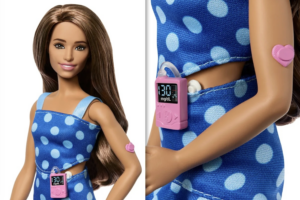
In July of 2025, Mattel announced a brand new Barbie doll, only this one was special. This Barbie was Mattel’s first doll to have Type 1 diabetes (T1D) and she sports a continuous glucose monitor (CGM), an insulin pump, and color theming to match global diabetes awareness symbols.
On the surface, there shouldn’t be anything wrong with this. It’s just a company making a doll to represent a chronic autoimmune disease that impacts roughly two million Americans of all ages. However, there was a good amount of backlash on social media following this announcement.
People said things like “this is so embarrassing,” “should make it obese so kids actually learn the lesson,” “Barbies are supposed to be hot not dying of random diseases,” “she definitely doesn’t have the body type to be diabetic,” “so it’s okay to promote that fat shit,” and “that’s more like it” with an image of the Barbie edited to make her overweight. Not only are these comments rude and ableist but they are also just factually incorrect.
A large portion of this backlash seems to have stemmed from people being uneducated about the difference between Type 1 and Type 2 diabetes (T2D), so, to start, let’s get some facts straight. T1D is an autoimmune condition where the body’s immune system attacks the cells in the pancreas and causes an inability to produce insulin. T2D is a condition in which the body either doesn’t produce enough insulin or what it does produce is ineffective.
The causes and risk factors for both types are not fully understood, though genetics are believed to play a role in each. And yet T2D is what people are thinking of most often when they imagine diabetes as it is the one that is more associated with obesity. However, obesity is neither the only risk factor nor a requirement to develop T2D; people can develop it at any weight.
Now that the facts are sorted, we can look at the blatant ableism these comments display. Comments like “this is so embarrassing” and “Barbies are supposed to be hot not dying of random diseases” frame disability as something that people should hide and be ashamed of, which is, unfortunately, how disabled people have historically been treated. These ideas suggest that non-disabled bodies are superior and the ideal, while disabled bodies are inherently less desirable. Comments like “should make it obese so kids actually learn the lesson” and “she definitely doesn’t have the body type to be diabetic” reflect the belief that diseases are a punishment for “bad behavior,” which directly employs the ableist and widely-rejected moral model of disability.
In response to this ableist backlash, many people tried to explain the difference between T1D and T2D; however, in the process they fell into almost the same ableist trap. “Response to the latest Barbie doll justifies its existence” is an article that serves as a good example of how this happened, likely inadvertently. In this article, the author describes the differences between Type 1 and Type 2 diabetes, much like I did earlier, but in a way that almost seems to be putting down T2D in order to validate T1D. In describing the difference, the author says, “This is [an] entirely separate illness from Type 2 diabetes, which is caused by an unhealthy diet.” This sentence serves to do two things, the first of which is to create a divide between Type 1 and Type 2 diabetes. The second is to moralize T1D while demonizing T2D in the process by making it seem like Type 2 is entirely the result of poor choices while Type 1 is innocent.
The article later goes on to say “Unlike Type 2 diabetes, which is often linked to lifestyle and can sometimes be prevented, Type 1 is chronic, incurable, and requires lifelong management,” which further enforces these same ideas. This wording serves to imply that Type 1 is worse than Type 2 and more deserving of sympathy and understanding while diminishing the impacts and other causes of T2D.
One of the closing lines of the article, which also hides this same covert ableism, is “When people confuse Type 1 and Type 2 diabetes, it not only diminishes the unique challenges of each condition – it contributes to harmful narratives that shame the very people who need support.” The phrasing of this sentence, though this may not have been the intent, serves to enforce this idea that Type 1 diabetics are more worthy and are victims of their disease, while those with Type 2 should be shamed and their disease is self-inflicted.
All of this, the backlash and the responses to it, reflect a larger pattern of the way society views disabilities and chronic illnesses. This framing of T1D as “innocent” and T2D as something people “bring upon themselves” participates in a long history of placing disabled people onto a hierarchy to decide which disabilities are “good” and which are “bad.” The idea of the “disability hierarchy” claims that certain disabilities are more acceptable than others based on how closely they approximate “normal.” This is an idea that dates back to ancient times and was most notably employed by the Nazis during the Holocaust in order to decide which disabled people were worthy of living.
It is important to note that my referencing of this history is not intending to equate social media misunderstanding diabetes to atrocities like genocide. Rather, the purpose is to show how these seemingly innate attempts to sort disabilities into categories is deeply rooted in ableism and eugenics. While the hierarchy today is less obvious than state policies deciding who gets to live or die, there are still very strong societal impacts. This invisible hierarchy influences how people decide who is worthy of empathy, visibility, and access versus judgement, shame, and exclusion.
In our modern context, disabilities are often ranked by how visible they or their effects are (e.g., physical symptoms, assistive technology). Then, they are further ranked by how much blame society assigns for developing them. Conditions that are widely genetic or accidental are seen as unfortunate and sympathetic while those associated, accurately or not, with lifestyle or the “consequences” of one’s actions are seen as deserved and shameful. This causes people to view disabled people as either “helpless victims” or “deserving of punishment,” neither of which are accepted ways of viewing disability in the disabled community.
Mattel’s T1D Barbie unintentionally served as a way for these beliefs to be brought into view. What should have been a wonderful piece of representation for young children (and adults) with Type 1 diabetes or even insulin-dependent Type 2 Diabetes was twisted into a vehicle for ableist beliefs. The backlash exposed how quick people are to assign moral judgement to chronic conditions and how deeply rooted the idea that some disabilities are more legitimate than others is into society.
The Barbie wasn’t the problem, the ableism that sparked the backlash and was hidden in the responses to said backlash was. Representation can’t do much in a society that still believes some bodies are worth more than others.
No one “deserves” their disability. No disability is “better” than another.
Related posts:
 Barbie Liberation Organiztion
 The Love and Lust for Convicted Criminals
Social Media Platforms
The Love and Lust for Convicted Criminals
Social Media Platforms
 OnlyFans: The Access to Child Pornography
 Destroying Art in Protest: Is it Worth it?
 Behind the Black Square: The Quiet Sabotage of Viral Activism
 Donating to the deprived or donating to TikTok?
Powered by YARPP.