
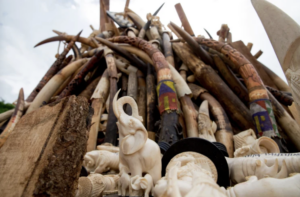
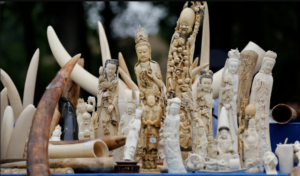
Ivory has been used in art and jewelry for millennia, carved into elaborate figurines and jewelry items to adorn spaces or people. Ivory art’s beauty and difficulty to obtain has led to it being considered an exclusive and valuable luxury item.
Elephant tusks have historically been the main source of ivory for art and trade, although walrus or hippopotamus tusk can also be used. At least 20,000 African elephants are killed by poachers for their tusks annually, a pattern that has severely destabilized elephant populations across Africa. All species of elephant are currently considered endangered, with African forest elephants suffering the most with the classification of critically endangered, primarily because of ivory poaching coupled with habitat loss.
Despite established and increasing regulation prohibiting poaching and ivory trafficking, illegal circulation of ivory continues. Demand in eastern Asia remains steadfast, continuing to incentivize organized crime groups to poach elephants for ivory, which they then smuggle to Asian countries. As much as 70% of smuggled ivory is sent to China to be sold as artistic trinkets or jewelry. Poaching is able to keep happening due to an insufficient number of enforcement agents, well-funded and violent criminals, and government corruption which enables poaching by criminal syndicates. In turn, these transnational poaching/smuggling criminal organizations are motivated to sow corruption in national governments and resort to violence against park rangers standing up to them. The result is vicious cycles which hurt both elephants and humans.
Concerted efforts to stop the illegal ivory trade are led by organizations like the World Wildlife Fund and are making inspiring progress. Strategies for ending ivory poaching include partnering with tourism companies to discourage ivory poaching, changing consumer behavior through market research and media campaigns, advocating for government level ivory bans, and dedicating resources to improve restorative programs. All of these methods are a part of larger conservation efforts to protect and revitalize elephant populations across Africa. Other components of the goal of elephant conservation include habitat protection and improving human-elephant interactions in the wild. Combatting illegal poaching and ivory trade is definitively actionable and significant for elephant conservation.
Material is a central component of creating art, and the source of those building blocks is deeply relevant to the art’s legality and morality. Even if the form of ivory art is beautiful and productive, it being sourced from illegally poached ivory from elephants that were cruelly killed means that it is a result of a crime with negative moral implications. Art should promote creativity and contribution through both material and form, not perpetuate cycles of crime and harm.

