
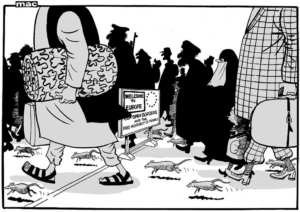
When people think of rats, people imagine the dirty streets of a big city infested with disease, disgust, and dumps. But in Germany, rats were people: and in need of exterminating. After WWI, the Germans struggled and needed an easy target to blame the failure of their nation on, birthing the stigma around Jewish Germans. Nazi propaganda was headed by a chief architect named Joseph Goebbels: a man who used mass media to inundate the German public with hate-filled antisemitic rhetoric, dehumanizing Jewish people, and framing them as an existential enemy. The Third Reich was notorious for the way they handled propaganda and carefully controlled public image. Goebbels spread hateful ideas, understood the power of those ideas, and deliberately used them to hurt people. He helped turn antisemitism into a daily part of German life through all channels of media. Goebbels showed that his loyalty to Nazi ideology mattered more to him than truth, human life, or even the lives of his own children.
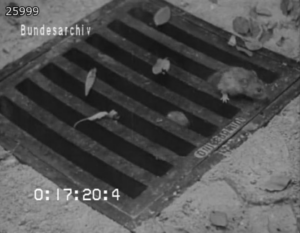
In one of his films, Der Ewige Jude, Goebbels explicitly juxtaposed footage of Jewish citizens with packs of rats to frame their extermination as a defensive public health measure- not a crime on humanity. It was mainly shot in Poland- one of the highest density Jewish and Roma countries at the time- and showed footage of rats moving through sewers alongside images of Jewish families, ghettos, and synagogues to create associations with filth, infestation, and disease. It staged the concept that poverty was due to the Jewish population in order to justify antisemitic laws, segregation, deportation, and eventually mass murder. It convinced German audiences that they were not fellow citizens, but a threat that needed to be eliminated.
In Der Stürmer, the weekly Nazi Germany tabloid, they even published posters and cover art. Over time, the image became so familiar that it did not always need an explanation: viewers were trained to understand what the rat represented. This was the power of the imagery. The public had been swayed to acceptance. It allowed the Germans to kill without rebuke. Der Stürmer helped solidify a hierarchy of human evolution by using animal imagery, where living beings held a specific rank and place- birthing and stimulating the growth of Aryan control in Germany whilst vilifying anyone of lower class.
Goebbels’s propaganda system also connects to the ideas of Edward Bernays, who demonstrated how mass media could shape public opinion by appealing to unconscious fear. Both understood that audiences could be influenced through repetition, symbolism, and the creation of an overarching “us versus them” identity. However, Goebbels transformed these techniques into a weapon of racial persecution. The rat imagery in Der Ewige Jude and Der Stürmer trained viewers to feel disgust toward Jewish people and made their removal seem necessary- no longer was their extermination just an option or choice to be made.
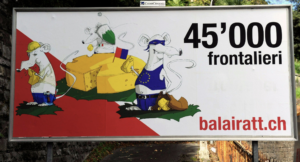
In 2015, rats resurfaced- just as Switzerland’s political climate was changing swiftly to the right. With the European migrant crisis from the instability in the Middle East followed by a terrorist attack in Paris, it led to major rehaul of immigration and border laws and an outbreak of xenophobia in Europe. The Swiss far-right party set up posters in Tessin, a region of Switzerland near the border of Italy, depicting an Italian Roma, construction worker, and the EU in rat form all taking a bite out of Swiss cheese. It had a figure, telling the public 45,000 migrants had entered Switzerland (but with no time frame). The website alongside the rats was Balairatt.ch, which means “rats dance”.
This was a blatant call for “outsiders” to stay out, and that the issues the country was facing had to be due to the immigrants entering the country. The timing and political environment brewed the perfect conditions to shape public opinion of voters. By reducing immigrants and minority groups to pests, politicians make them seem less human and less deserving of empathy, rights, or protection. The Swiss posters repeated the same strategy used by Nazi propaganda: create fear, assign blame, and present exclusion as a solution. Rats even gained a new sinister meaning in propaganda after their usage in Germany and yet, the posters were still made. This harms not only the people depicted in the poster, but harms the history that must be remembered to ensure it doesn’t happen again. When we try to forget the hard parts of history, it repeats itself, hurting more people in the future. There are countless innuendos in the media that alter how we see our society than we even know- drenched in historical importance that we almost never try to remember.
Related posts:
 Sculpting the Truth: Art and Power from Ancient Rome to Modern North Korea
 Tattoos: An Art or Crime?
 Be an Imperfect Fruit
 Japanese Art: Anime Banned
 The Sinister Motive Behind Fortnite’s Emotes
 The Entertainment of Exploitation
 Balenciaga Quasi-Scandal: “Toy Stories”
Powered by YARPP.