
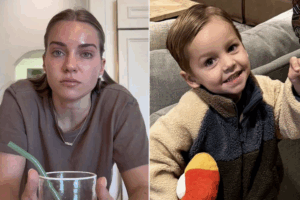
In the influencer era, private life has become a form of public labor. Mothers film their morning routines, children grow up before millions of strangers, and audiences come to believe that closeness is the same as connection. Nowhere has this tension between intimacy and exposure become more painfully clear than in the aftermath of the drowning of Emilie Kiser’s young son, Trigg Kiser. What should have existed entirely within the protected realm of family was instead absorbed into the machinery of digital culture. A mother’s grief became a landscape for public commentary, speculation, and consumption.
Before the tragedy, Kiser’s content was built on a soft aesthetic of domestic calm. She recorded herself making breakfast, cleaning her beautiful home, and narrating the ordinary challenges of motherhood with tenderness. Her videos projected emotional steadiness and a sense of gentle order. Followers turned to her content the way one might return to a calming ritual, something predictable and reassuring in an unpredictable world. Her brand rested on that sense of ease, and her audience responded with unwavering loyalty.
That familiarity, however, created a deeper problem. The more personal a creator’s content appears, the stronger the illusion of relationship becomes. When Kiser’s son drowned in the family pool this May, the news spread across social media within hours. Suddenly her followers felt entitled not just to updates but to understanding. The speed with which the tragedy became communal rather than individual reveals an unsettling truth about digital intimacy: it gives audiences a sense of ownership over lives that are not their own.
However, that sense of ownership escalated into something far more disturbing. Within days of the accident, one of Kiser’s followers physically went to her home, stood outside her window, and filmed her inside the house during one of the most vulnerable periods of her life. The video revealed how easily the line between being a follower and becoming a trespasser can disappear, collapsing the distance that normally separates online spectatorship from real-world intrusion.
What makes this moment so unsettling is not only the violation itself but the cultural conditions that permitted it. It exposed the way digital audiences can justify behavior that once would have been deemed socially unacceptable. The follower who recorded that video likely believed she was documenting something meaningful, as if her involvement were a natural extension of her investment in Kiser’s life. In a different context, such an act would be recognized immediately as deviant, even criminal. Yet within the world of influencer culture, where personal narratives are constantly framed as something to interpret and decode, the trespass was treated by many viewers as content rather than a crime.
This incident reflects a larger pattern that cultural criminology works to understand. When a family’s grief becomes part of a public story, the line between genuine empathy and intrusive entitlement can begin to fade. A home, which should represent privacy and protection, can suddenly feel like an extension of the online world, a space where outsiders believe they are allowed to look in. The follower’s actions reveal how normalized this soft form of surveillance has become in a culture that encourages people to observe, comment on, and involve themselves in the lives of strangers. What happened at Kiser’s window was not just one person making a poor choice. It showed how easily social media, emotional investment, and widespread fascination can turn a private tragedy into something viewed collectively, and how that transformation can make behavior that should be unacceptable seem strangely reasonable to those watching.
In this sense, the intrusion into Kiser’s home is not only a personal violation but a cultural one. It reveals how easily public attention can shift from compassion to consumption and how the dynamics of digital intimacy can authorize behavior that crosses into the realm of actual harm. The follower may have believed she was acting out of concern, but her camera transformed that concern into surveillance. The moment underscores a larger truth that the world of art, media, and crime often makes visible. Under certain cultural conditions, acts of transgression can be disguised as participation, and violations of privacy can be mistaken for care.
In the weeks that followed her son’s death, Kiser did what any mother in her position would do. She stepped back. She disappeared from the platforms where she once shared her daily life. Yet in her silence, the audience continued to speak. They speculated about her marriage. They criticized her decision to create content as a parent. They debated whether she was responsible for what happened, implying that their opinions belonged within a family’s private suffering. The language of parasocial closeness created a space where empathy and intrusion became almost indistinguishable.
When Kiser finally returned to social media, she did so quietly. Her post was brief and rooted in sorrow. There was no attempt to craft a narrative or to satisfy the public’s endless hunger for explanation. “The last few months have been really, really hard,” Kiser said. “I’m not going to sugarcoat it. I’m not going to lie. I’m not going to sit here and act like things are fine and dandy.” Her words were honest and unembellished, a moment of sincerity offered not as content but simply as a mother trying to articulate her pain.
Still, some followers created videos analyzing her facial expressions in her newer posts, insisting that her attempts to resume any sense of normalcy meant she needed therapy or professional help in order to process her son’s death. Another video went further, offering unsolicited advice by claiming she should divorce her husband, Brady, who had been responsible for watching their son when the accident occurred. In that video, the creator urged her to “get rid of him,” adding that she “would never want to look at him again,” suggesting that a stranger’s judgment could stand in for the layered complexity of a family’s grief. Kiser’s sorrow, which should have remained beyond public interpretation, was instead treated as a text for strangers to interpret and debate. The audience, conditioned by years of curated closeness, struggled to accept that some emotions cannot be explained, packaged, or processed for them.
This moment exposes the cost of the intimacy economy. Influencers are praised for their authenticity and rewarded for the willingness to open their lives to viewers. But when tragedy occurs, the same openness becomes a trap. A creator who has built a career on relatability no longer has the freedom to grieve in privacy. The audience who once loved her gentleness becomes an audience that feels entitled to every detail of her suffering. The relationship collapses under the weight of expectation, and what remains is not empathy but surveillance.
The drowning of Kiser’s son is not an influencer scandal or a cultural talking point. It is a devastating loss. Yet the way it unfolded online reveals something unsettling about the digital world we have created. Audiences claim to seek authenticity, but often what they want is access. They want to feel included in moments that were never meant to be shared. They want to transform private reality into communal experience, even when doing so magnifies someone else’s pain.
Kiser’s tragedy forces a necessary reckoning with the ethics of consuming personal content. It asks why the boundary between compassion and curiosity has become so thin that viewers cannot always tell when they have crossed it. It asks why motherhood, grief, and healing have become forms of narrative content that people feel allowed to interpret. It asks why a family’s greatest loss became immediately intertwined with the expectations of millions who believed they personally knew her.
At its core, this story extends far beyond one woman’s online presence. It reflects a culture that has blurred the line between emotional access and emotional entitlement. As the boundary between creator and audience continues to dissolve, Kiser’s silence becomes a quiet reminder that some experiences are not meant to be witnessed. Her return to the internet is not an invitation for analysis but an act of survival, a sign that her grief was never meant to be consumed as content. It is simply a mother enduring the unimaginable in a world that increasingly treats private pain as something to interpret, discuss, or even judge. In this way, her story reveals how cultural forces can normalize forms of intrusion and deviance that once would have been unthinkable, exposing just how fragile the boundary between care, curiosity, and harm can become.
Related posts:
 Donating to the deprived or donating to TikTok?
 When Home Movies Become Work: Family Vlogging and Childhood at Stake
 Sun, Sex, and Surveillance: Love Island’s Panopticon Paradise
 The Problem with Social Media
 Tiktok and Its Crime Encouraging Antics
 All in a Media Moment: Social Media and Social Justice
 Zach Bryan and Brianna Chickenfry: Their Love ‘Fried’ Out
Powered by YARPP.