
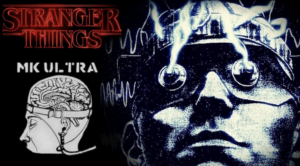
Netflix’s exclusive original hit Stranger Things premiered in 2016 and has become one of Netflix’s most-watched shows, breaking viewer records. Although Stranger Things is a horror science fiction series, its portrayal of “Hawkins Lab” represents real fears during the Cold War era and government-approved programs, such as MK-Ultra. By turning secretive experimentation into a record-breaking series, this show sensationalizes human abuse and the stories the U.S. government covered up. At the same time, it also brings attention to government corruption and what harm can be caused to vulnerable people. Therefore, Stranger Things can be viewed as a piece of work that dramatizes real stories for audience entertainment or as a narrative that exposes government crime.
The top secret CIA project, MK-Ultra, began in the midst of the Cold War when hysteria was created around the Soviet Union and China having tools to brainwash. Subsequently, the United States began experimenting through the use of LSD and other drugs for mind control, psychological torture, and interrogations. Project MK-Ultra roughly took place between 1953 and 1964, but details regarding the program did not become public information until 1973 through government investigations. This project included numerous human subjects, most of whom were unknowingly or unwillingly participating in these drug experiments. The CIA approved and funded MK-Ultra access to universities, hospitals, and prisons where these experiments were conducted. Operation Midnight Climax was one of MK-Ultra’s biggest trials, where government-employed prostitutes drugged men in “CIA safe houses” and observed their behavior. Not only were these experiments done on normal U.S. citizens, but also on respected colleagues, including one well-renowned scientist, who was drugged with LSD at a “CIA-sponsored meeting” and allegedly committed suicide a few days after.
The similarities between Hawkins Lab and MK–Ultra demonstrate how the entertainment industry took real events and morphed them into fictional horror. Like MK-Ultra, Hawkins Lab operated in secrecy, targeting vulnerable people who were unaware they were test subjects. However, Stranger Things adds symbolic horror figures, such as monsters and supernatural powers, to heighten viewer engagement.
Government secrecy is one of the strongest correlations between MK-Ultra and Hawkins Lab. In the series, Hawkins Lab operates behind a government-controlled narrative, allowing these experiments to occur in the center of town. Since these experiments are happening without public knowledge, the children test subjects have no outside protection or support. Similarly, the CIA destroyed records of MK-Ultra, making it increasingly difficult to investigate what really happened during drug trials. In both fictional and real examples, the government abused its power to conceal and protect itself from public scrutiny. By portraying this secrecy as horror, Stranger Things suggests government control can become especially dangerous when there is no check on power and no accountability.
In both fictional and real portrayals, this type of government secrecy often leads to intense public fear. During the Cold War era, American officials were fearful of the Soviet Union and China, which pressured the CIA to find its own methods of brainwashing, mind control, and manipulation. The urgency of the Cold War pushed out ethical responsibilities and morals, including informing the subjects and obtaining consent. Once these experiments became public knowledge, Americans started looking at their own government and shifting fear to their leaders. Likewise, in Stranger Things, the residents’ lack of information, coupled with random disappearances and unexplained events, created fear throughout the community. This suggests that, in both circumstances, fear can be fostered or exacerbated by authority figures withholding knowledge. However, for the television series, the use of monsters and supernatural phenomena makes the suspense more dramatic and creates fear within the audience.
Ultimately, Stranger Things raises the question of whether the inspiration behind MK-Ultra was able to bring awareness to government crimes without sensationalizing individuals’ trauma. At what point does the fictionalization distract audience members from connecting to its social commentary? The question remains whether exposing audiences to fictional stories helps them understand real government crime or just gives them another series to binge.
Related posts:
 How far is too far?
 Crime of the Mind
 Risks and Rewards of Legalizing Psychedelic Access
 Peyote And Sorcery
 The Ethics of True Crime Media and Its Implicit Consequence
 Criminal Attraction: The Romanticization of Serial Killers
 When True Crime Stops Being True: Netflix’s Commercialization of the Lizzie Borden Case
Powered by YARPP.