
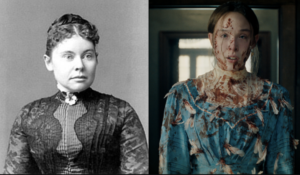
Lizzie Borden has been dead for almost a century, but people still debate whether she murdered her father and stepmother, Mr. and Mrs. Borden. Many have heard the famous nursery rhyme about Lizzie and the axe before they have any true knowledge about the case. On August 4, 1892, Andrew and Abby Borden were found murdered inside their Fall River, Massachusetts, home. Lizzie became the main suspect as she was inside the house around the time of the murders and gave statements that raised speculation about her whereabouts and reasoning for not hearing the murders occur. However, the evidence against her was circumstantial, and on June 20, 1893, a jury found her not guilty after deliberating for about 90 minutes. No one else was ever charged, and the case remains unsolved to this day. Even though Lizzie was acquitted in court, she was never fully acquitted in the eyes of the public and spent the rest of her life surrounded by rumors and suspicions. The mystery has continued through books, movies, television shows, and true-crime discussions. Netflix’s Monster: The Lizzie Borden Story is the newest telling of this story. However, the series fabricates multiple pieces of evidence and creates relationships in the show that give the audience a clear answer to a case that history has never solved.
One of the largest changes in the series involved Bridget Sullivan, the Borden family’s live-in maid, whom the family called “Maggie.” Netflix portrays Lizzie and Maggie as having a romantically tense relationship and shows Maggie helping Lizzie plan the murders and destroy evidence. However, there is no reliable historical evidence proving that the women were romantically involved or that Bridget had participated in the crime. While Bridget was inside the house on the day of the murder and became an important witness, her testimony was just a description of her household responsibilities and what she saw and heard that day. The show also connects Lizzie to the murder of Betha Manchester, portraying Manchester’s death as a practice run before Lizzie kills Andrew and Abby. In reality, Manchester was murdered in May 1893, about nine months after the Borden murders, while Lizzie was already awaiting trial. Finally, the series changed the timeline of Lizzie’s friendship with actress Nance O’Neil. Netflix shows Nance teaching Lizzie how to appear innocent during her trial, creating the idea that Lizzie’s courtroom behavior was a performance, when historically the two women did not meet until 1904, which would be more than a decade after the murders. Together, these changes make Lizzie appear more calculated than the available evidence proves.
The concern is not limited to the Lizzie Borden season. Netflix’s first Monster, Jeffrey Dahmer, in the series Dahmer Monster: The Jeffrey Dahmer Story, surpassed one billion viewing hours within its first 60 days, and the success helped turn Monster into an ongoing show series. The Dahmer series follows the basic facts of a solved case more closely because Dahmer confessed and was convicted, unlike Lizzie Borden. However, it still received criticism from victims’ relatives, as the mother of victim Tony Hughes said her son’s story did not happen the way it was portrayed in the series, while other family members said that recreating their experiences caused them additional pain. The Menendez season also faced criticism for suggesting an incestuous relationship between Lyle and Erik, which the brothers have rejected. This shows a pattern in which crime becomes a starting point, but speculation and fictional details are added to make each season more dramatic.
Artistic license is not automatically wrong because scripted series often need to imagine conversations or combine events. However, it becomes ethically questionable when fictional details are presented in ways that viewers may accept as legitimate history. This is especially concerning in Lizzie Borden’s case because she was acquitted and the murders remain unsolved. Yet, the series gives her another victim, an accomplice, and an acting lesson designed to help her describe a jury. Netflix has the right to interpret a case, but it should clearly identify which parts are documented and which were invented, as many viewers do not research cases afterwards and the series may be the only version they know. When fictional details become more memorable than the available evidence, artistic license begins to rewrite history rather than simply interpret it.
Related posts:
 Crimesploitation in 2022
 Murder, Mystery, & Makeup
 Unsolved Mysteries: Public Involvement in Crime Solving
 Murder, Mystery & Makeup
 The Ethics of True Crime Media and Its Implicit Consequence
 Criminal Attraction: The Romanticization of Serial Killers
 Murder, Mystery & Makeup
Powered by YARPP.