

JonBenét Ramsey captivated the public long before her tragic death with a carefully curated image from her success in child beauty pageants. By the age of six, she had already earned an impressive collection of titles, including Little Miss Colorado, Little Miss Charlevoix, Colorado State All-Star Kids Cover Girl, America’s Royal Miss, and National Tiny Miss Beauty. With makeup, sparkly gowns, and the perfect smile, she wasn’t just a kid, but a symbol of innocence, charm, and what many Americans imagined the “perfect little girl” to look like. But there was a darker side to this. These pageants demanded performance, adult-style presentation, and exaggerated “cuteness.” Her image was commodified and even sexualized, a problem perpetuated by child beauty pageants. That persona made for an irresistible story when tragedy struck, setting the stage for the media frenzy entangled with exaggerated false narratives that would shape how the case was investigated.
On the morning of December 26, 1996, six-year-old JonBenét Ramsey was reported missing from her family’s home in Boulder, Colorado, after her mother Patsey found a ransom note demanding $118,000. The police arrived at the house, and shortly after, JonBenét’s father, John Ramsey, discovered her body in the basement. The autopsy revealed she had died from strangulation and blunt-force trauma, with signs that suggested sexual assault. Almost immediately, the case became a national media sensation. America’s “sweetheart” had been brutally murdered, and the public, both fascinated and horrified, ate up every detail. Coverage fixated on her family, her childhood in the spotlight, and the mysterious circumstances of her death, spinning narratives that would dominate headlines.
By the mid‑1990s, American media had become a spectacle. News outlets competed for attention across magazine covers, newspapers, and the rapidly expanding cable networks, with 24‑hour news cycles turning every high-profile story into breaking headlines. In this era, what became known as “infotainment” emerged; a reporting style that blurred the line between news and entertainment, emphasizing drama and spectacle over straightforward reporting and the truth. Attention-grabbing headlines dominated covers and TV screens, framing high-profile crimes as narratives designed to sell for the most profit. JonBenét Ramsey’s murder fit perfectly into this media landscape: a child pageant star brutally and mysteriously murdered. Coverage didn’t just inform the public, it wrote its own stories, turning real people into characters and inviting speculation through various dramatized narratives.
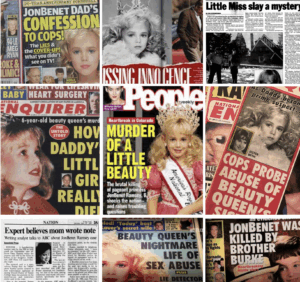
In the weeks, months, and even years following JonBenét’s death, media outlets jumped on her family as the story’s focal point. Tabloid and mainstream publications ran captivating headlines suggesting parental involvement, including accusations that her mother wrote the ransom note, that her father had confessed to police, or that her brother Burke was responsible. They fixated on and magnified small details, such as the ransom note amount coinciding with John Ramsey’s Christmas bonus, and unusual fibers on JonBenét’s clothing to support these theories. However, proper analysis disproved many of these claims: handwriting experts ruled out Patsy Ramsey as the author of the note, and there was no evidence implicating Burke. Yet the media’s relentless focus on these narratives shaped public assumptions of the Ramseys’ guilt long before the investigators and lawyers reached any conclusions.
The media’s obsession with the family had clear consequences for the investigation. Initial responders failed to secure the crime scene, potentially compromising critical evidence, while early police attention centered almost exclusively on the Ramseys, leaving other leads unexplored. Leaks to reporters further fueled speculation, and DNA evidence that ultimately excluded the family was withheld, allowing false narratives to dominate public perception for years. These investigative missteps were revisited in the 2024 Netflix documentary series Cold Case: Who Killed JonBenét Ramsey?, directed by Joe Berlinger. The three-part series highlighted flaws in the early investigation, the media’s role in shaping false narratives, and the ways in which the family was unfairly demonized. Featuring extensive interviews with John Ramsey and critiques of both law enforcement and media coverage, though critics have stated it has a “pro-Ramsey” bias. Taken together, the documentary illustrates how the intersection of dramatized media and flawed investigative practices shaped both the public memory of the case and the ongoing challenges in achieving justice.
Decades after her death, JonBenét Ramsey’s story remains unsolved and endlessly revisited, largely because the media frenzy surrounding the case became inseparable from the crime itself. As a child pageant star, she was already in the public eye as an objectified and sexualized figure, and tabloid headlines and 24-hour news coverage blew up these absurd theories and claims, turning her death into a melodrama. Wild, often false stories overshadowed the fact that a six-year-old had been killed, while flaws in the police investigation were overlooked. This shaped public perception, amplified trauma for her family, and turned a personal tragedy into a cultural object. JonBenét’s case demonstrates the ethical challenges of representing and commodifying crime, showing how media narratives can transform real-life horror into entertainment, blurring the line between fact and fiction.
Related posts:
 The Media’s Role in Relation to Kobe Bryant and “Tiger King”
 My Favorite Murder
 “I’ll know it When I See It”: The Line between High End Fashion and Child Exploitation
 Balenciaga: Social Media’s Role in Cancel Culture
 Dancing with a Con Artist
 The Moralization of Killing other Killers
 Collecting Killers: True Crime Memorabilia as Artifacts of Evil
Powered by YARPP.
This post really brings to light the conflict between an actual case and people looking in from the outside, and how it affects the attention given to cases. In the one provided in the post, people became much more fixated on JonBenét Ramsey’s family and those that surrounded her rather than her, the actual victim. It reminds me of the recent Lindsay Clancy case and how self-proclaimed online “detectives” became dedicated to proving that she was not responsible for the deaths of her three children, but rather, it was her husband and he tried to kill her too but failed. This type of thinking took social media by storm and trying to prove Lindsay’s innocence became a huge moment of fixation. Meanwhile, there was no consideration or care for the actual three children murdered. People can easily be caught up in their own beliefs, but this does not warrant taking away the actual facts of cases or events.
I love how you set up your article to show us how JonBenet Ramsey was more than just a murder victim, but rather a child with massive success in the pageant scene. I find your article very interesting in how you explain that the media turned JonBenet Ramsey’s death into a dramatic story instead of focusing on her as a real child and victim. Her pageant image created the idea of a “perfect little girl,” which made the case more appealing to the public and easier for media outlets to sensationalize. I was especially disturbed by how unsupported theories about her family were repeated so often that many people began to believe they were facts. I like how you highlighted how media pressure and investigation mistakes can interfere with justice while causing even more pain for the family. Overall, I agree that the case demonstrates the danger of treating real tragedies like entertainment.
This article perfectly explains the impact that public attention can have on an investigative case. The media and individuals were way too wrapped up in their own theories that it actually harmed the police investigations. This reminded me a lot of the self-proclaimed true crime detectives on social media today. There are endless accounts dedicated to true crime cases and theories for those cases. This can be overwhelming to an already hectic case, and cause more harm than good. Unfortunately people get so fascinated with the dramatic details of cases and tend to forget there are actually real people involved.
This article is a perfect example of how the public can adopt a narrative that aligns with them and run with it. I found this article especially interesting after watching the Netflix documentary Who Killed JonBenet Ramsey? Ramsey’s representation, tragic death, and the fact that her case remains unsolved demonstrate how uncertainty encourages people to draw their own conclusions, leading them to put all the blame on Ramsey’s family. Because people became emotionally invested, the hysteria around unanswered questions and conflicting evidence made it difficult to separate speculation from evidence.
I want to start off by saying I really like how you first acknowledged that before JonBenet was ever a victim of a murder, she was the victim of the child beauty pageant world, which heavily sexualizes children. Not only that, but it creates an image of them people heavily focus on, which I feel does not help in this tragic story. As you mentioned, narratives shaped public assumption and the people who declared who was guilty themselves before anything was ever confirmed. Honestly, I feel if she wasn’t a child pageant star, there would not have been as much obsession and conspiracy around her case. Your article perfectly sums about what happened and how she honestly never got the true chance to receive justice in her case, all because of obsession.
This article is a major example of how media obsession can blur the lines between facts and fiction. With fake claims and theories circulating the internet, the case became a collection of conspiracies rather than straightforward facts. Public perception shaped the way the case proceeded, tormenting the family with fake claims. This horrific real-life crime turned into a piece of entertainment for the public, as people tried to solve it themselves. While media can be a great aid when discussing news and events, it can also spiral out of control with fake narratives. It is important to stick to the facts rather than feed into the chaos. Another example of this is a podcast I recently listened to for a class called “Radiolab’s War of the Worlds”. This podcast studied different radio stations that broadcast fake news as a joke and caused an immense amount of chaos among people who thought they were in danger. This is another example of blurring the lines between reality and fiction and how sometimes it is best to check your facts and not believe everything you hear.