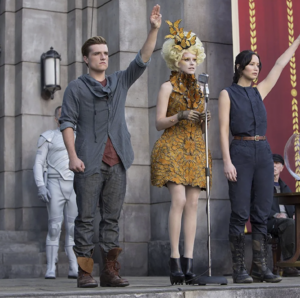
From the first read or first watch of any of The Hunger Games movies or books, it seems far-fetched and unrealistic. However, if we look a little deeper, Suzanne Collins’ depiction of political corruption has many similarities to our own government. This series is a futuristic dystopia that represents the political state of our country, but regardless of the parallels to our society, we aren’t collectively able to see this real-life corruption in the same way. This speaks volumes about our society and the inability to look at things from an analytical perspective, because we are so caught up in the reality set up by our government.
This leads me to the first parallel between our society and the dystopian world created by Suzanne Collins: the population of Panem is brainwashed similarly to many Americans, which has normalized the cruelties of the government and the casualties of innocent people. The Hunger Games is a dramatization of a dystopian society because of the extreme central concept that 24 children are randomly selected to compete to their deaths every year, in order to “maintain stability” in their country. Although these 23 fictional deaths per year are horrifying, it puts things into perspective when we compare them to the thousands of lives that have been taken in Palestine, the families that have been torn apart by ICE, the women who have suffered due to abortion restrictions and sexual assault, and the children that have been killed in school shootings. This doesn’t even begin to account for all of the cruelty of our government and the innocent lives that have been destroyed, but many Americans don’t even give this cruelty a second thought. War, immigration laws, gender inequality, and gun violence are just a few of the many things in our country that are normalized. This raises the question of why this violence and bloodshed are accepted, which leads back to the agenda of who holds the power and wealth of the nation.
In The Hunger Games, the country is separated into districts based on the products that they produce. However, this groups them based on wealth, so their society is essentially segregated based on social classes. The protagonist is from the poorest district, where almost everyone lives impoverished, and can barely afford to stay alive. The audience follows her character throughout the books and movies, so we are able to see the awful treatment of these people and the devastating impacts it has on their lives. Although our society isn’t directly segregated in the same way, we do have very distinct social classes, which leaves millions of Americans living below the poverty line, while the top 1% hoards the majority of the wealth and power in our country. Why is it that people reading The Hunger Games books can sympathize with Katniss and agree that no one should be forced to live like that, but impoverished people in America don’t receive the same empathy?
One example that has helped me to try to understand the answer to this question is from a scene in The Hunger Games. The richest and most influential people in the Capitol are at a party, and they have a special drink for when they are full, which forces them to throw up so they can eat more. “Everyone does it, or else how would you have any fun at a feast?” It stands out because it conveys how greedy these people are. Most of the country is starving, yet these people are forcing themselves to throw up so they can eat more food. We can see this mindset in today’s world because billionaires and large corporations have more money than they could ever spend. For example, if Elon Musk “spent $1 million per day, it would take him 2,740 years to spend $1 trillion,” yet he and many others still exploit the lower class and trash our planet to make even more money. People who live comfortably aren’t willing to sacrifice their comfort for others, which is the issue with our world today. If something doesn’t impact them personally, they won’t vote for what is right or stand up for change. This pattern can be seen throughout history and, in my opinion, is one of the biggest factors that contributed to Trump’s re-election.
The Hunger Games is a widely popular story, but the central message gets overlooked. It is difficult to see the flaws of a system that you have lived in your entire life and been conditioned to see as normal, which is why stories like this are so important. This piece of art exposes the crimes of our government and the flaws of our political system. We need to view it as a warning of what happens when power goes unchecked, and take the initiative to stand up for the citizens of our country, rather than supporting the agenda of a capitalist system that only provides for a small fraction of our population.