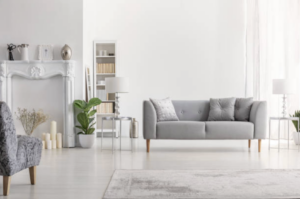
Imagine, you walk into your room at the end of a long day, all you want to do is sit on the couch, light a candle, and relax. You walk across your vinyl floors to your imitation wood cabinet, open the drawer, but rather than feeling wood you feel the laminate- and even the candle you go to light sits on a coffee table not made of wood or glass or metal, put rather fiberboard, particleboard, and acrylic paint. As you sit on your polyester couch you realize- this room doesn’t relax or ground you at all- It feels fake and incomplete, and inauthentic to yourself.
The rise of synthetic materials in interior design and architecture has devolved the age-old art and passion of the individual decorating a space to make it feel inauthentic, sterile, inhospitable, and unlived in, the exact opposite of how a space is supposed to feel. Your space is an extension of your individuality, a reflection of your life and a conglomerate of all of your experiences. Synthetic materials and furniture are destroying the culture of design, decorating a space and can be considered an act of vandalism to the space and culture of your home, depleting the individuality from your space.

Interior design has been a practice traced back to Ancient Egypt, Greece, and Rome. These civilizations prioritized usage of luxury materials such as marble or gold, with intricate details and features. For centuries, people have wanted to decorate their spaces and homes to reflect their individuality, shared and valued experiences, and to create an atmosphere of comfort for the individual. One of the easiest ways to create comfort and earnestly reflect yourself was to use earnest materials to ground the space and convey the feeling the individual wishes. For example, wood on the floor, stone on the island, tile on the wall; using different materials to decorate your space has been an art since the beginning of time.
Faux materials became popularized in the interior design and architecture industry during the industrial revolution. The boom of manufacturing allowed for mass produced designs and furniture that used to be considered “luxurious” became available for a better price to the middle class. To make it more affordable to produce, faux materials and synthetics were introduced in manufacturing and interior design. Suddenly, leather couches became synthetic, polyurethane or PVC vinyl couches. Solid hardwood floors turned into laminate or luxury vinyl plank with a fiberboard or a plastic core. Traditional wall tiles became peel and stick vinyls or PVC panels. This is not to mention the countless coffee tables, bookcases, bedframes, and storage bins that traded in real materials for synthetics.

The art of interior design turned itself into the art of illusion via synthetics. Somewhere along the line we lost the cultural value of real materials and traded it for the illusion of luxury, downgrading ourselves to the illusion of luxury rather than a space of lived experience.
One problem with synthetic materials in the home or other spaces is how it affects the value of the room. Plastic based materials began in order to convey luxury as a cost effective angle, but at what other cost? These types of furniture are now so mass-produced, cheaply made, and so many pieces infiltrate one space it can degrade the quality and feel of the room. It can lead to a space feeling inauthentic and lacking tactile warmth, aiding senses, and bringing natural elements into the home. It brings human forward spaces towards uniform and structured aesthetics rather than imperfections and our unique tie to the natural world.
Another problem with the rise of synthetic materials in the home that aid in the destruction of cultural design is the quality and durability of the space. Plastic based furniture and embellishments often come with poor structural durability, not only looking fake but being structurally incapable of serving its intended purpose after a couple of years. In turn, the breakdown of these materials, which often include plastic, can release harmful chemicals and pollutants within the space. Adhesives and resin can give off volatile organic compounds and formaldehyde – a classified carcinogen and harm the environment and the person’s health (Solid, 2025).
In summary, although that new coffee table from Target or Ikea or Walmart you just bought may fit the “vibe” or your space, be cheap, and claim to be durable- how much are we willing to save to later pay the price of lacking real materials in our homes?